Fence Installation FAQ — Joplin, MO
Straight answers to the questions we hear most from Joplin property owners, whether the job is a backyard privacy fence or a half-mile of pasture fence. If your question is not covered here, tell us about your property and we'll answer it directly.
How much wind does a fence around Joplin actually need to hold up to?
There is no single number, because it depends on the fence style and how it is built, not just the location. A solid privacy fence catches wind like a wall and needs closer post spacing, adequate post depth, and solid footings to handle the gusty spring storms that move through southwest Missouri. An open-style fence — chain link, split rail, most farm wire — lets wind pass through and puts far less stress on the posts during the same storm. If wind is a real concern for your property, the fix is almost always in the posts and bracing, not the panel material itself.
A storm just took part of my fence down — now what?
First, check that nothing is live or dangerous — a panel down near a power line is not a do-it-yourself situation. Once it's safe, photograph the damage before moving anything, in case you file an insurance claim. Then look at whether it's isolated damage (a few panels, one leaning post) or the whole line — isolated damage is usually a straightforward repair, while a fence that failed along its entire length often has an underlying issue, like posts that were never set deep enough to begin with. Either way, get it assessed before the next storm finds the same weak point again.
Will homeowners insurance cover storm damage to a fence?
Often, but it depends on your specific policy and what caused the damage — wind and falling-tree damage are commonly covered under standard homeowners policies, while damage from ordinary age and rot generally is not. Check your policy or call your agent before assuming either way, and keep photos of the damage plus a copy of the repair quote, since that is what an adjuster will typically ask for. We can give you a written quote to support a claim, but the coverage decision itself is between you and your insurance company.
How tall can I build a privacy fence in Joplin?
Most residential areas allow a taller fence — commonly up to six feet — in back and side yards, with lower limits for anything facing the street, but the exact rule depends on your zoning, your lot, and whether you're on a corner. Corner lots especially can carry sight-distance rules that limit fence height near the street for driver visibility. Before you build, it's worth a quick call to the city to confirm what applies to your specific lot — we'll build to whatever height gets approved, but the approval itself is on the property owner.
Is chain link a good fence for a yard with dogs?
For most dogs, yes. Chain link is hard to chew through, lets the dog see out (which cuts down on fence-line barking for some dogs and, admittedly, worsens it for others), and it's one of the more affordable ways to enclose a full yard. Two things matter most for dogs specifically: height, since a determined jumper needs more fence than a dog that never tries, and how tight the bottom of the fence sits to the ground, since digging under is a more common escape route than climbing over. A known digger may need the bottom of the fence buried or staked down as part of the install.
What kind of fence actually holds cattle?
Woven wire and high-tensile smooth wire are the two most common choices for cattle in this area, with woven wire generally doing better against calves and more determined animals, and high-tensile costing less per foot over a long fence line. Barbed wire is still common on established pasture fence, though a lot of newer installations skip it in favor of high-tensile or electric. Horses are a different case — barbed wire is generally avoided for horse pasture because of injury risk, with woven wire, pipe, or well-built board fence preferred instead. The right answer depends on the animals, the terrain, and how long a fence line you're working with.
Should a cedar fence be stained?
Left bare, cedar weathers to a silver-gray color over a couple of years, which some homeowners like and others don't. Staining protects the wood from UV and moisture and keeps the warmer color most people picture when they think "cedar fence," but it's maintenance you'll repeat every few years as the stain wears, especially on faces that get full sun most of the day. A clear or semi-transparent sealer is the lower-maintenance middle ground — less color change than a solid stain, but still some UV protection for the wood underneath.
What does fencing typically cost per foot in Joplin?
Costs vary by material and by the specifics of the yard, but as a general starting point: wood privacy fencing typically runs somewhere around $25 to $45 per linear foot installed, chain link typically runs lower, roughly $15 to $25 per foot, and vinyl privacy fencing typically runs higher, around $30 to $50 per foot. Farm and ranch fencing is usually priced differently — by the foot for materials, but planned around total fence line length, since a quarter-mile of pasture fence prices very differently than a hundred-foot yard fence. Ground conditions, gate count, and how much old fence needs to come out first all move the number, so a real quote needs a look at the actual property.
How deep do fence posts need to be set?
As a general rule, a post should be set roughly a third of its total length into the ground — so a post standing 6 feet above grade is commonly set around 2 feet deep, more in loose soil or on taller fence sections, sometimes less where shallow bedrock or heavy rock limits how deep a hole can practically go. Corner, end, and gate posts typically need to go deeper and get more concrete than the line posts in between, because they carry more of the structural load across the whole fence.
What's the real difference between vinyl and aluminum fencing?
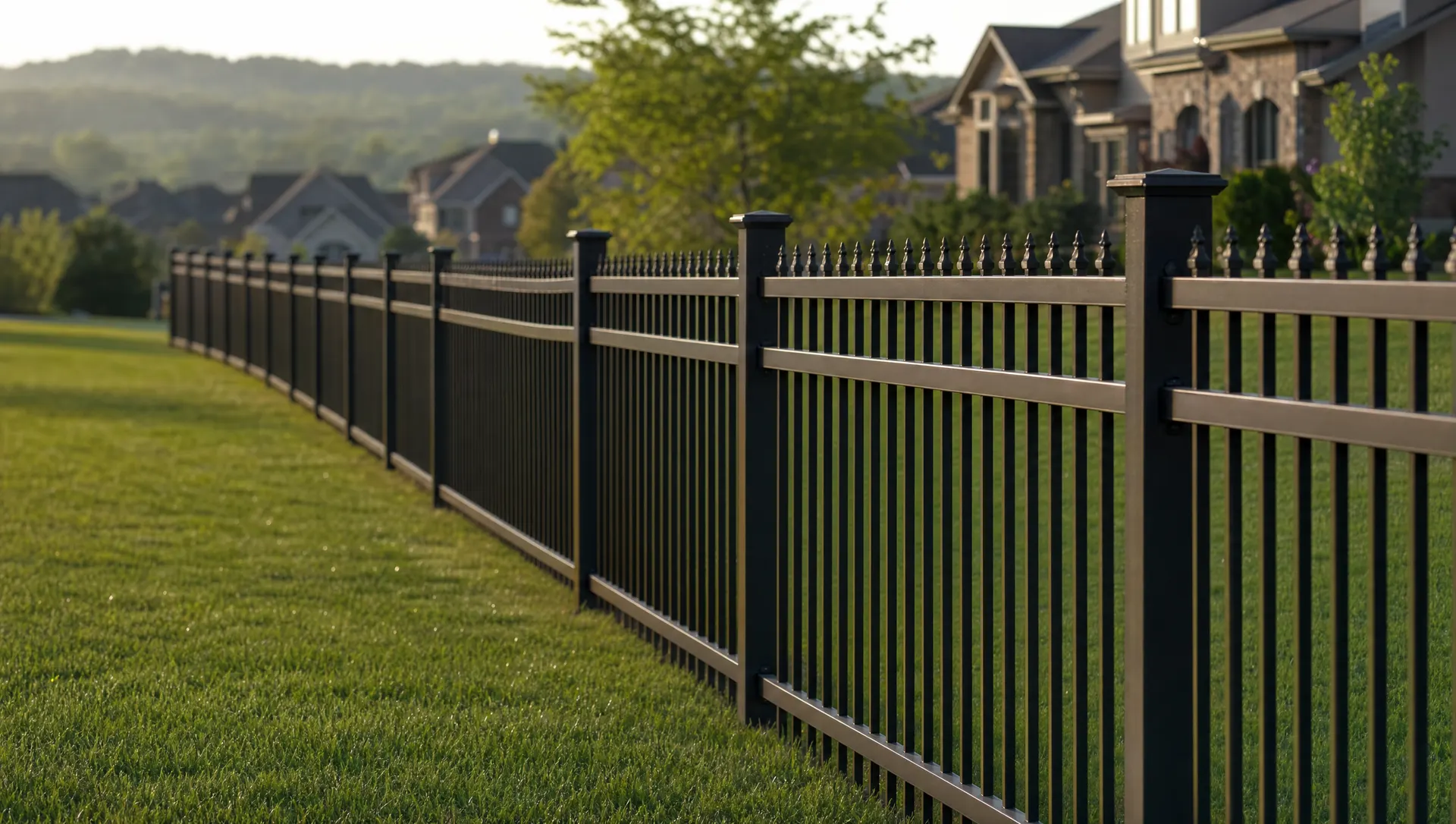
Vinyl is a solid or semi-solid panel, most often used for privacy or a picket look, and it doesn't rust, rot, or need paint — the tradeoff is that in real cold it can get more brittle, and a hard impact can crack a panel. Aluminum fencing is an open, rail-and-picket style, closer in looks to wrought iron, commonly used for pool enclosures and front-yard fencing where you want a defined boundary without blocking the view. Both hold up well through Joplin's weather swings and need very little upkeep compared to wood.
Do you need a utility locate before digging fence post holes?
Yes, and it applies to any post-hole digging, not just big excavation jobs. Missouri's one-call system gets underground lines — gas, electric, water, fiber — marked before digging starts, it's free to request, and it protects you from hitting something you really don't want to hit with a post-hole digger or auger. We build the locate timeline into the schedule so it doesn't hold up your install.
How long does a typical fence installation take?
A standard residential yard fence often installs in one to a few days once materials are on site, depending on total footage, gate count, and ground conditions. Larger jobs — a full farm fence line, a big commercial lot — take longer and are usually scheduled around weather, since post-hole work and concrete don't go well in the middle of a downpour. We'll give you a realistic timeframe once we've seen the property and the scope of work.
Is it worth repairing an old fence, or should I just replace it?
It depends on what's actually wrong with it. A fence with a few bad posts, a sagging gate, or some cracked pickets scattered through an otherwise sound line is usually a good repair candidate. A fence where most of the posts are rotted at the base, the line leans as a whole, or it's old enough that matching material is hard to find is often more cost-effective to replace outright rather than patch piece by piece. We'll tell you honestly which category yours falls into instead of defaulting to whichever option is more work for us.
Still Have Questions?
Every property is a little different. Tell us about yours and we'll get back with a free, no-pressure quote and straight answers to whatever we didn't cover here.
Putting Up a Fence in Joplin?
Tell us about the property and we'll get back fast with a free, no-pressure quote.